

This metric which was once native to SaaS companies is now scoring companies, firms and agencies far beyond its industry.
The rule was designed for SaaS companies with $50M+ in revenue. But now, ten years after debut, it's travelled downmarket, across categories, and into the diligence templates of the buyers now circling other businesses as well.
What the Rule of 40 actually is
The formula is two numbers added together.
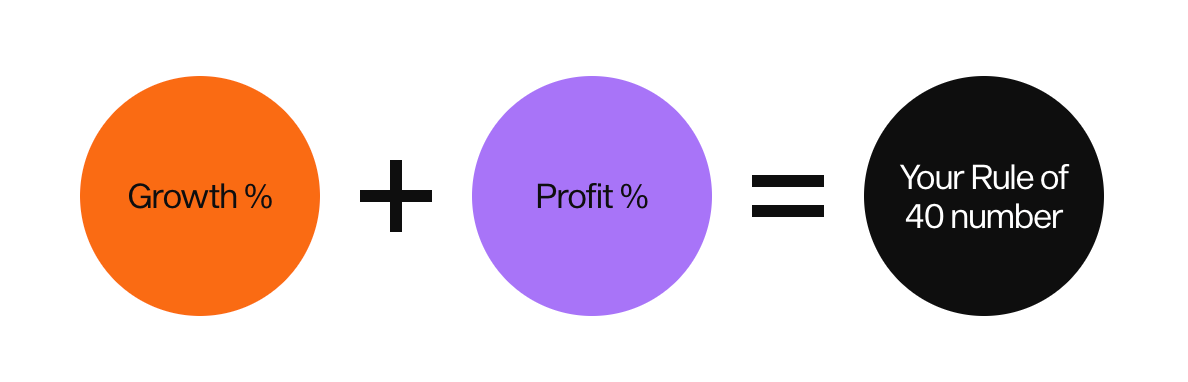
- Growth input can be ARR or MRR or net fee income
- Profit input is EBITDA
- Time period is usually trailing 12 months over the prior 12.
Three examples of a business hitting the 40 threshold:
- 20% growth on a 20% margin (balanced)
- 40% growth on a 0% margin (growth-led)
- 0% growth on a 40% margin (profit-led)
Why it now applies to agencies and creators
The Rule of 40 travelled so well because it lets a buyer normalise across categories on the same page. A PE firm looking at three potential agencies, one SaaS, one productised and one creator led can score all three on the same framework and rank them by capital efficiency.
Where most agencies actually score
Let’s try to understand this with an example:
Business A: £4M revenue, 5% growth, 12% margin. Score of 17. Buyer offers 4.5x adjusted EBITDA. Deal on the table: £2.16M enterprise value.
Business B: £4M revenue, 25% growth, 20% margin. Rule of 45. Buyer offers 9x adjusted EBITDA. Deal on the table: £7.2M enterprise value.
Same revenue, same category but a different structure leads to £5M+ gap on the valuation.
Businesses in the top bracket get platform pricing at 8-12x EBITDA and beyond whereas project-heavy service businesses trade at 4-5x.
Why you can't fake it
If a business is in the market for an exit, and figures out that they don’t score well on this metric, their obvious first move will be to strip out overhead, defer the hires, delay the marketing spend. But that won’t work.
These are the three levers actually move the number:
- Productise the core offering. Fixed-scope engagements, named service tiers, documented delivery methodology, priced deliverables that don't move mid-project. The business runs the same way no matter who is on the other side of the table.
- Decouple revenue from linear headcount. Revenue per FTE climbs year on year when tech-enabled delivery reduces hours per project and AI-assisted workflows let the same team produce materially more output.
- Build pricing power that holds when the founder steps back. Contracts should sit with the business rather than the founder personally. The senior team should be empowered enough to run commercial conversations.
Each of these is a 6-18 month project, layered over 2-3 years. When the work is done correctly the score moves for real.
Run your own number
Year-on-year fee income or ARR growth (%) + EBITDA margin (%). Where does your business land?
The scorecard:
- Below 15: You have some significant structural work ahead. Invest 18-24 months of deliberate value creation before going to market. If you sprint into an exit from this level then you’ll have to dish out the largest discount.
- 15-25: You’re on the ladder, but you still have 12-18 months of focused work ahead of you. There is potential for you to move into the premium bracket.
- 25-40: This is where the progress starts showing up. With 6-12 months of tightening on margin, revenue quality and retention, you can push your score above 40.
- 40+: You’re in the platform bracket. Your buyer pool changes significantly and the diligence gets more technical. This is where your valuation multiple compounds.
Where to start
The Rule of 40 is the one of the many scores that buyers consider a substantial report card of your business.
At @Succeed, we’ve consolidated all of them into our Exit Readiness Diagnostic. In five minutes, you’ll leave with a specific view on where you're structurally strong, where you're exposed, which dimensions you need to prioritise and roughly how long the work takes.
Take the Exit Readiness Diagnostic