
.jpg)
Exit readiness isn’t a feeling. It’s a set of proofs.
Most agency founders don’t fail to sell because the work is weak. They fail because, under scrutiny, the business doesn’t feel ownable, and that changes everything about how a buyer prices it.
Revenue can look strong. The brand can look strong. The client list can look strong. But buyers aren’t buying a vibe, and they’re definitely not buying a founder’s belief that things will “work out”. They’re buying a future cash flow with as few surprises as possible.
That’s what exit readiness really is: a business that can survive scrutiny without the founder having to explain it away.
This is why most agencies aren’t exit-ready, what buyers are actually seeing when they look at your business, and what to fix first if you want to become buyer-grade.
The uncomfortable truth
Most agencies are built to deliver, and they can be excellent at client work while still being uninvestable. Not because they are “bad”, but because they are fragile in ways that don’t show up in the day-to-day.
Fragile businesses rarely feel fragile from the inside. They feel busy, full, and in demand, and that can be addictive because it looks like momentum.
But buyers don’t buy momentum. They buy control.
They look for proof, not promises, and they look for systems, not heroics, because they’re trying to answer one question in a hundred different ways: can this be owned without the founder holding it together?
Buyer-grade, not busy.
What buyers are really asking
A buyer doesn’t sit down and ask whether your agency is “good”. They ask whether it’s understandable, durable, transferable, and containable.
So the questions sound like this:
Can I trust what I’m looking at?
Will revenue hold when ownership changes?
Does this run without the founder being the glue?
Are the risks contained, or are they hiding in the edges?
Can I own this cleanly, without consent surprises and IP gaps?
Most founders answer those questions with context, because context is how the business feels inside.
But buyers aren’t buying context. They’re buying comfort, and comfort comes from evidence.
Reason 1: The numbers do not feel controlled
The buyer’s question here is simple: do they know what’s true?
This is where deals start to wobble, even when profitability is real, because the buyer can feel when the business is being explained rather than evidenced.
It shows up in small tells. A buyer asks for revenue by client and gross margin by service line, and you can produce it, but the number changes depending on which sheet you open. Or margin dips, and the explanation is “it was just this month”, even though there’s no clean bridge that shows what actually drove the change. Or add-backs sound plausible, but the evidence trail behind them is thin.
You can still be profitable. You can still be growing. However, if a buyer cannot reconcile the story quickly, they have to price in uncertainty.
And uncertainty tends to turn into terms. A lower multiple. More deferred consideration. A holdback that suddenly appears. More conditions. Longer diligence. Slower momentum.
Not because buyers are mean, but because they’re protecting themselves.
Exit readiness starts with truth. Truth requires control.
Reason 2: Revenue looks strong, but durability looks weak
Buyers don’t ask, “How much revenue do you have?” They ask, “How likely is it to stay?”
This is where strong agencies get discounted, because the buyer is looking at how revenue behaves when conditions change, not how it behaves when the founder is in the room.
The usual culprits are predictable: concentration that exists but isn’t actively mitigated, contracts that are inconsistent or missing, key relationships that sit with the founder, and a pipeline that looks big, but isn’t staged or evidenced. Sometimes you also have “recurring” revenue that’s technically recurring, but only because nobody has tested what happens when renewal pressure arrives.
A buyer can love your clients and still protect the deal if they think revenue could wobble post-acquisition. Durable demand beats impressive demand.
If you want one move that changes how revenue reads, it’s this: make it legible in one place, without interpretation.
The Top 20 Client Table (build it, use it)
Create one table for your top clients (by revenue or gross profit) that you can share without flinching:
- Client
- Fees last 12 months and percentage of total
- Gross margin
- Renewal date and notice period
- Contract type (retainer, project, MSA + SOW, informal)
- Relationship owner (day to day)
- Delivery owner
- Change-of-control consent required (yes or no)
- Risk notes (what could wobble)
- Mitigation (what you are doing, by when)
This table does two things at once. It forces you to face what is true, and it makes it easier for a buyer to get comfortable without having to “decode” your business.
Reason 3: Founder dependence is hiding in plain sight
This is the one founders avoid because it feels personal, even though it’s mostly structural. Founders call it quality control. Buyers call it key person risk.
If the founder closes most deals, retains key clients, solves escalations, sets pricing, and acts as the delivery quality filter, then the agency might be high-quality, but it’s not ownable yet. A buyer can’t underwrite a business that collapses when the founder steps back, even if the founder has no intention of stepping back.
The biggest discount in agency M&A is the hero founder. Exit readiness is the process of removing that discount.
The buyer will build a dependency map anyway, so you should build it first and use it as your plan.
Founder dependence: the 30-day test (what buyers are modelling anyway)
Buyers are always running the same thought experiment: “If the founder vanished for 30 days, what stops working?”
Not because they expect you to vanish, but because it exposes where the business runs on a person instead of a system.
So do the exercise before they do. It takes an hour, and it makes founder risk legible.
How to do it:
Create a simple table and be brutally honest. You aren’t trying to look good. You’re trying to locate risk so you can reduce it.
Fill it in like this:
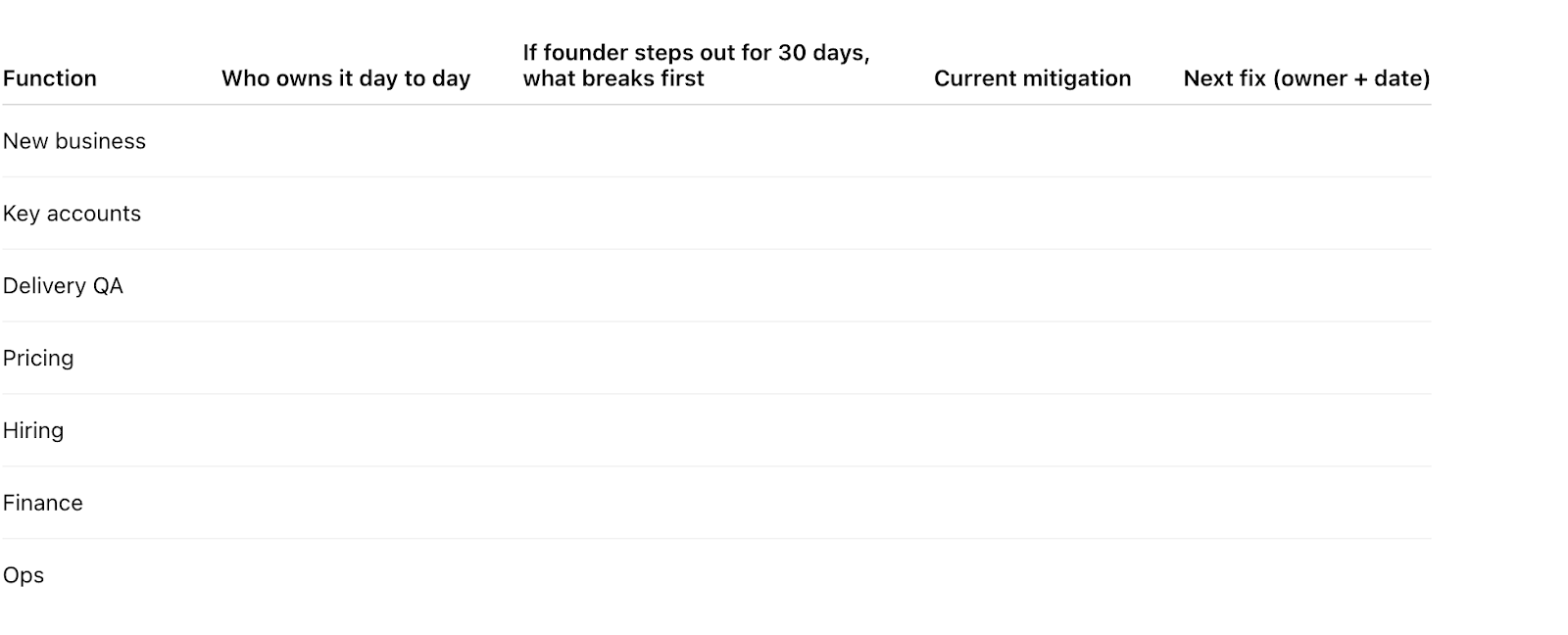
Don’t write “everything” or “nothing”. Be specific.
Examples of good answers:
“Proposals stall because only the founder signs pricing.”
“Renewals drift because only the founder has the relationship history.”
“Quality drops because QA sits in the founder’s head.”
“Escalations become slow because the founder is the default decision-maker.”
“Cashflow gets messy because finance is not closed monthly without the founder.”
If nothing breaks, great. Write what would keep running and why.
What this table is for
This isn’t bureaucracy. It’s a plan.
You’re aiming for two outcomes:
A buyer can see you understand the dependency points.
You can show you’re actively reducing them.
The buyer-grade rule
Founder involvement is normal. Founder dependence gets priced.
Buyer-grade isn’t pretending it’s fine. It’s being able to say:
“Here’s where I still sit today, here’s what already has coverage, and here’s what will move off me next, by when.”
That one sentence changes the buyer’s internal narrative from “key person risk” to “managed transferability”.
Reason 4: The business runs on people’s heads, not systems
Agencies often confuse talent with infrastructure, especially when delivery has “always worked” because good people care.
But you can have a brilliant team and still have an unownable business if delivery is inconsistent, onboarding varies by account lead, scope creep is managed emotionally rather than structurally, utilisation isn’t actively managed, and QA depends on whoever’s available. When those things are true, margin becomes fragile, and the buyer can feel it.
Buyers don’t need a thousand SOPs. They need proof that work is won and delivered in a consistent way, and that consistency doesn’t depend on the founder carrying it.
A buyer isn’t buying your current team. They’re buying your operating system.
Reason 5: Tightness is missing, so risk isn’t contained
This is where great agencies get surprised, because the work is excellent and the clients are happy, but the legal and structural edges are loose.
Buyers will ask whether contracts are assignable, and whether any trigger consent on change of control. They’ll ask whether you actually own the IP, including contractor work. They’ll look at liability caps and indemnities, and they’ll test single points of failure in suppliers, platforms, and key tools. They’ll look for disputes and hidden obligations.
Even one weak area can convert into protection mechanics, because the buyer has to contain risk they can’t quantify. Escrow. Heavy warranties. Price chips. Retention-linked deferred consideration.
Exit readiness means risk isn’t only known. It’s contained.
The simple model that holds up in any room
If you want one framework that survives a room full of advisors, it’s this:
Truth. Transferability. Tightness.
Truth: do the numbers tie out, and can you explain them cleanly?
Transferability: can the agency run without founder heroics?
Tightness: are risks contained, contracted, and controlled?
Most agencies fail because they only have one of the three, or because they have all three in fragments but nothing is packaged and usable.
Exit readiness is having all three, with proof.
The myth that keeps founders stuck
“We will get exit-ready when we decide to sell.”
Reality: by then, you are negotiating from weakness.
Once you enter a process, you start paying the uncertainty tax. More diligence pressure, more renegotiation, more fatigue, more value leakage. And because the business still has to run while you do all that, performance often dips at the worst moment.
Diligence isn’t where you fix weaknesses. It’s where weaknesses get priced.
A micro case: what “not exit-ready” looks like
An agency has strong revenue and a recognisable brand. A buyer leans in. Heads nod. An LOI lands.
Then diligence starts, and the edges begin to show. Revenue is concentrated. Contracts are inconsistent. Margin moves month to month without a clean explanation. The founder is the relationship glue.
Nothing catastrophic happens. No scandal. No crisis.
But buyer confidence quietly shifts.
The buyer doesn’t say, “We don’t like you.” They say, “We need protection.”
Price reduces. Earn-out grows. A holdback appears. Timelines stretch. The founder gets tired. Delivery performance dips. The deal does not explode, it decays.
That’s what non-exit-ready looks like. Not drama. Drift.
What to do instead: the buyer-grade 90-day plan
You don’t fix exit readiness in a weekend, but you can change the signal in a quarter.
Days 1–30: Build Truth
Single source of truth numbers pack. Revenue and margin by client. A one-page monthly margin explanation. Defined pipeline stages and a cleaned pipeline. One page of known risks with owners and dates.
Outcome: a buyer can understand what’s true.
Days 31–60: Build Durability
Top 20 Client Table kept current. Contract gaps fixed on key accounts. A concentration mitigation plan. Change control and pricing discipline. A simple retention rhythm for key accounts.
Outcome: revenue looks like it will hold.
Days 61–90: Build Transferability
Founder dependence mapped, and one dependency point removed. Secondary owners assigned to top clients and transfer begins. Core processes documented and actually used. Key staff risk identified with a retention plan. Weekly operating cadence in place (numbers, pipeline, risks).
Outcome: the business starts to feel ownable.
Buyer-grade isn’t a brand exercise; it’s a discipline.
The line that matters
Exit-ready means a buyer can trust your earnings, trust revenue will hold, and trust the business runs without you.
Truth. Transferability. Tightness.
Build those, and exit readiness stops being a hope. It becomes a predictable outcome.
Take the Succeed Exit Readiness Assessment
Strong revenue isn’t the same as buyer confidence.
This assessment shows where buyers will discount you (Truth, Transferability, Tightness), where value is most likely to leak, and the next best action to become buyer-grade.
Take the Exit Readiness Assessment
If you’re considering a process in the next 6–12 months, get a Succeed Business Valuation to see how buyers are likely to price your agency today, and what would move the number before you go to market.