

When a buyer values your agency, they're not really valuing your agency. They're valuing your agency without you in it.
They are trying to predict how your team will function without you.
Does your team work just as smoothly with:
- new leadership?
- new colleagues?
- new priorities?
These questions are why the team structure gets a significant amount of attention in diligence. We’ve seen three key risks that if addressed early on can multiply the valuation.
‘Gap at the top’ risk
Buyers want to see a leadership layer below the founder. Specifically, they want to see a team who could run the business if the founder stepped back tomorrow. This is the second-in-command problem, and it's one of the most common issues in agencies.
The founder has passionately built their business through their own energy and judgment. The senior team is talented but always has to operate within the founder's framework. There's no clear successor because nobody has needed to be one.
When the buyer sees this structure, they either lower the valuation or negotiate for a longer founder lock-in period.
The solution for this needs to happen at least 12 months before going to market, but ideally 18 to 24 months. The role title varies (Managing Director, COO, sometimes Deputy CEO or a Chief of Staff) but the function is the same: someone who can take operational responsibility for the business, who clients and team treat as a peer to the founder, and who can credibly answer the questions the buyers will ask in diligence.
The founders who hesitate to hire their second in command are either forced to hire one during the sale process or end up accepting a deal structure that ties them in for years longer than they wanted.
'Key person’ risk
The exact opposite of the gap at the top is key person risk.
Key person risk is the buyer's term for any team member whose absence would substantially damage delivery, retention, or revenue. The founder is usually the most obvious one. But the list almost always includes others.
- The creative director who owns the relationship with your biggest client.
- The head of strategy whose thinking shapes every major pitch.
- The operations lead who's the only person who knows how the production process actually runs.
- The senior account director who'd take three clients with her if she left.
- The right hand man who project manages the entire agency
Buyers find these people by asking the right questions in diligence. Ask yourself, who would you struggle to replace? who do clients ask for by name? who'd you call in a crisis?
If the name of one of your team members is coming up frequently, you should fix the problem by:
- Cross training: so that critical knowledge sits with more than one person.
- Documentation: so the knowledge exists outside anyone's head.
- Retention planning: so that the people who genuinely are central to the business have a reason to stay through and beyond the transition.
‘Core team retention’ risk
The senior team members who matter most to the deal are usually the last ones to find out about it because founders worry about destabilising the business by telling people too early.
But the cost of that is significant.
Buyers often expect senior team members to be locked in before the deal closes. They want stay bonuses agreed, retention packages structured, and in many cases, equity rolled into the new entity. If those conversations haven't happened, the buyer will either delay the deal while these get sorted, or price the uncertainty into the offer.
These are the exact questions that need to be answered 12 to 18 months before going to market.
- What is the future shape of the business
- Where does each senior person fit into it
- What does the team want from the business in the next three years
- Does their compensation reflects their value
- Is there a path to equity or some other form of long-term participation
Founders who have these conversations with their team early on arrive at the deal with a senior team that's already aligned. The retention packages then become a confirmation of existing intent, not a negotiation in the middle of diligence.
Founders who haven't had these conversations find out about the potential risk at the worst possible moment when one their senior team members are at flight risk. The buyer finds out about it at the same time and calculates the valuation accordingly..
What this looks like in combination
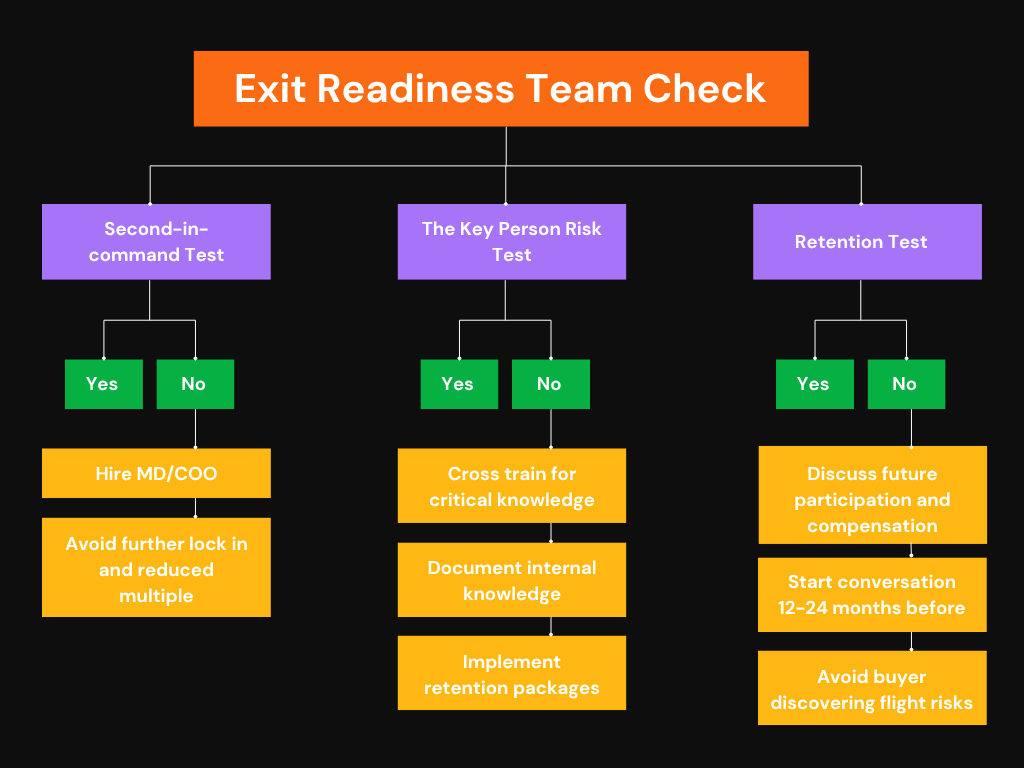
Together these three answer the question the buyer is really asking: what am I actually buying, and how much of it depends on people who might not be here in two years?
Where to start
You don't need to solve all three at once. If you're 12-24 months out from going to market, the order usually looks like this:
- Get the second-in-command in place first.
- Then run the key person risk audit.
- Then start the retention conversations.
If you want a second pair of eyes on where your team sits against these three questions, book a call with the Succeed team today. We'll walk you through the exact same framework we use with agencies going to market.