EOT vs MBO: which internal exit actually fits your agency?
Tax, cash, control and leadership. A plain-English guide from Succeed, part of Unusual Group, on choosing between an Employee Ownership Trust and a Management Buyout—and the commercial traps founders miss.

Not every agency founder wants to sell to a network, a private equity roll-up, or a larger competitor. For many of the founders we advise at Succeed, part of Unusual Group, protecting the agency's independence, culture, and client relationships matters just as much as the headline number.
When a trade sale is off the table, two internal routes dominate the UK agency market: an Employee Ownership Trust (EOT) and a Management Buyout (MBO). On the surface, both achieve a similar goal—handing the agency to the people who helped build it while allowing founders to realise value. Under the bonnet, however, they are completely different transactions. They behave differently on tax, cash flow, leadership incentives, and who carries the risk for the next five years.
Here is how both routes really work in the UK market today—including what the 2025 and 2026 Budgets changed—and how we help founders decide which one fits.
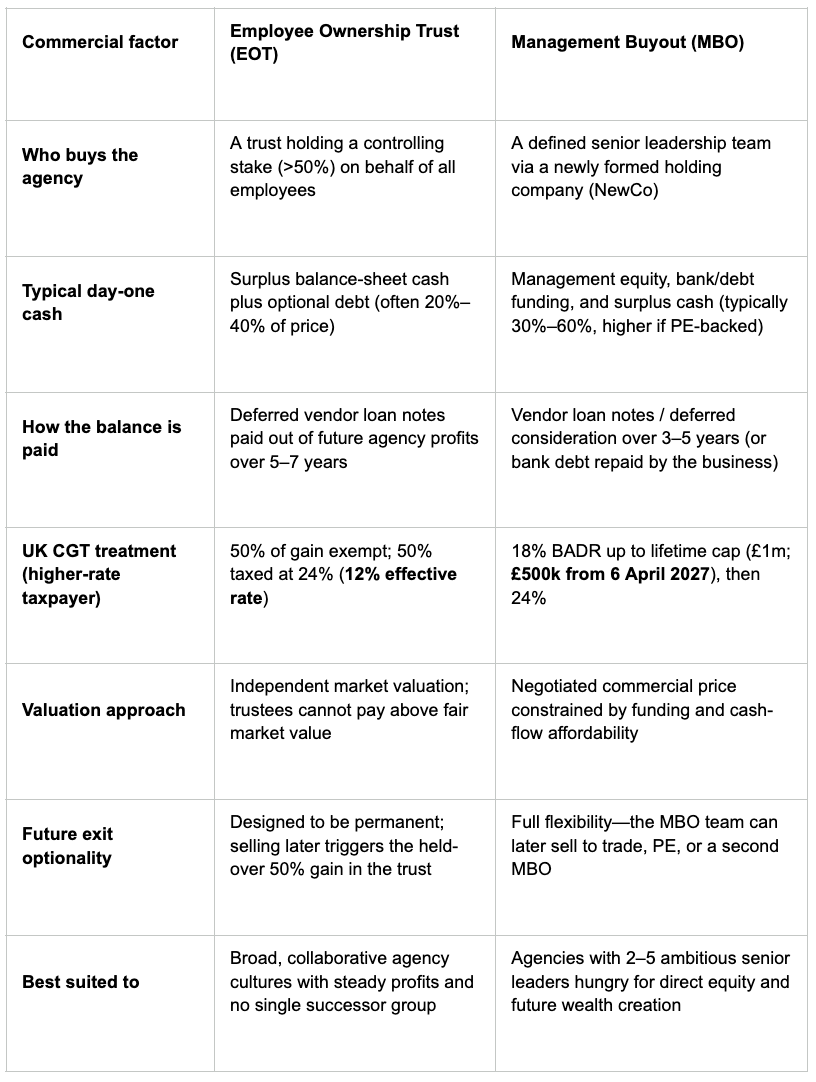
EOT vs MBO at a glance
How an EOT works in practice
In an EOT sale, founders sell a controlling shareholding—anything from 51% to 100%—to a dedicated trust established for the long-term benefit of all employees. Employees do not buy shares out of their own pockets. Instead, the trust funds the acquisition using surplus cash already inside the agency, occasionally supplemented by third-party debt, with the remaining balance paid to the founders in instalments out of future post-tax profits.
For agencies, the appeal is obvious. The process is usually faster, less adversarial, and far less disruptive to clients than a trade sale. There is no aggressive external buyer picking through your contracts looking for a price chip, and staff can receive annual bonuses of up to £3,600 free of income tax once the agency is EOT-owned.
What founders sometimes underestimate is how strict the governance rules have become. Following the reforms introduced in October 2024, an EOT must be genuinely independent to qualify for tax relief:
- No founder control: Former owners and connected persons must make up less than half of the trustee board and cannot retain control through the trust deed.
- UK residency: The trustees must be UK resident as a body.
- Independent market value: Trustees are legally required to take reasonable steps to verify they are paying no more than fair market value—and no more than a reasonable commercial rate of interest on deferred loan notes.
- Four-year clawback: If the agency breaches EOT qualifying conditions within the four tax years following the year of disposal, HMRC can claw back the vendor's tax relief.
There is also a people reality we flag in almost every EOT conversation: broad ownership does not create leadership. Handing equity to a trust does not automatically produce a managing director, a commercial rainmaker, or a finance lead. Worse, if two or three senior directors are carrying the weight of new business while everyone shares equally in the upside, resentment builds quickly. In those cases, a hybrid structure—pairing an EOT majority with targeted direct equity or Enterprise Management Incentive (EMI) options for key leaders, which Budget 2026 confirmed remain protected in EOT transitions—often solves the problem.
How an MBO works in practice
In a Management Buyout, your senior leadership team steps up directly as the buyer. Usually, they incorporate a NewCo to acquire 100% of the agency from the founders, funded through a mix of management's own capital (often called "hurt money"), surplus cash in the agency, external bank or private equity debt, and deferred payments owed back to the founders over three to five years.
The commercial strength of an MBO is crystal-clear alignment. The people running the agency every day own the equity directly. They have personal capital at risk, direct control over strategic decisions, and the freedom to build toward a larger trade or private equity exit of their own down the line. For ambitious managing directors and client partners who want genuine wealth creation—not just a modest annual bonus—direct equity is far more motivating than indirect ownership through a trust.
Where MBOs stumble in the agency world is almost always funding and dynamics:
- The affordability gap: Agency leaders rarely sit on large pools of liquid personal cash. Unless the agency is big enough to attract private equity backing or significant cash-flow lending, the founders end up acting as the bank—carrying substantial vendor loan notes with fewer external guarantees.
- The negotiation dynamic: Negotiating valuation, warranties, and deferred payment terms across the table from your own leadership team is delicate. Left unmanaged, a buyer who wants a cautious price and a founder who wants full market value can fracture trust before the ink dries. This is where independent sell-side representation earns its keep: putting a seasoned adviser between founder and management preserves the relationship while keeping the deal commercial.
The tax picture after the 2025 and 2026 Budgets
A great deal of outdated commentary still describes EOTs as "tax-free exits." That era ended on 26 November 2025, when Budget 2025 halved EOT Capital Gains Tax (CGT) relief from 100% to 50%. Today, half the gain on a qualifying EOT disposal is taxed at standard CGT rates—24% for higher-rate taxpayers, producing an effective rate of 12%—while the remaining 50% is held over inside the trust. Business Asset Disposal Relief (BADR) cannot be claimed on the taxable half.
When that cut landed, many founders assumed MBOs and trade sales had caught back up. Then Budget 2026 moved the goalposts again. With BADR already sitting at 18% (up from 14% in 2025/26), the government announced that the BADR lifetime limit will halve from £1m to £500,000 for disposals completing on or after 6 April 2027. Because EOT relief was left untouched, the tax gap widened back in the EOT's favour.
To see what that means in hard cash, take an illustrative £4m capital gain for a sole UK founder (higher-rate taxpayer, full BADR unused, ignoring the annual exempt amount):

On a £4m gain, the EOT leaves the founder £420,000 better off before April 2027, and £450,000 better off after it.
There is, however, a cash-flow catch that catches founders off guard under the post-2025 EOT rules. Because 50% of the gain is now immediately chargeable to CGT on disposal, your tax bill falls due on the 31 January following the tax year of completion—even if 75% of your sale price is sitting in multi-year vendor loan notes. Before committing to an EOT, we always model day-one liquidity first: your completion payment (from surplus cash or sensible debt) must comfortably cover the tax bill, legal and advisory fees, and a meaningful initial cash payout.
Four questions we ask before recommending either route
At Succeed, we never let the tax tail wag the commercial dog. Saving £400,000 in CGT means very little if the agency struggles to service your loan notes in year three. When we sit down with agency founders weighing an EOT against an MBO, the right answer almost always emerges from four honest questions:
- Who is actually going to run the agency after you step back? If you have two to four proven leaders who already own client relationships, win pitches, and want the risk and reward of owning the company outright, an MBO harnesses that drive. If leadership is broader—or still developing—an EOT (potentially paired with a senior EMI option pool) gives you time to transition stewardship without betting the entire business on one or two individuals.
- How predictable is your cash conversion? Both EOTs and debt-funded MBOs are paid out of future operating profit. Project-heavy agencies with lumpy revenue and high client concentration carry real repayment risk under either model. Recurring retainer income, clean margins, and a healthy balance sheet make internal exits far safer.
- How fast do you want your cash off the table? An EOT is a patient exit: founders typically wait five to seven years to collect full proceeds. A leveraged or PE-backed MBO can release more cash at completion, though it brings bank covenants or investor oversight into the boardroom.
- What do you want the agency to look like in ten years? If preserving independence and building a lasting, employee-owned legacy matters deeply, an EOT was built for that purpose. If your senior team's real ambition is to double the agency over four years and sell it to a global group, an MBO keeps that runway clear—whereas an EOT structure actively penalises an onward sale by triggering the held-over 50% tax charge inside the trust.
Choosing the right route starts before you pick one
Neither an EOT nor an MBO is a shortcut around exit preparation. Both require the exact same fundamentals that attract premium trade buyers: clean financial reporting, strong leadership depth below the founders, diversified client revenue, and reliable cash generation. Without those pieces in place, an EOT struggles to fund its loan notes and an MBO struggles to raise debt.
Because Succeed operates within Unusual Group—working alongside agency founders from early growth through to exit—we see how much stronger your options look when you prepare two or three years ahead. Even if you favour an internal exit today, building a trade-ready agency gives you the leverage to choose freely between an EOT, an MBO, or an external buyer when the moment arrives.
If you are weighing up your exit options over the next few years, start with our Exit Readiness Assessment. It benchmarks where your agency stands today and highlights the exact commercial gaps to close before you commit to a structure.
Ready to explore your options?
The right deal isn’t just money. It’s choice. It’s knowing what you built will keep thriving in the right hands.