What does it cost to sell an agency?
Advisers, lawyers, accountants, tax and time. A plain-English guide from Succeed, part of Unusual Group, on the real commercials of an agency exit; and what we tell founders to check before signing anything.

When agency founders first sit down with us to talk about an exit, the opening question is almost always the same: what is my agency worth? The second, usually asked much later than it should be, is what it will actually cost to get the deal across the line.
At Succeed, part of Unusual Group, we have guided founders through every shape of UK agency transaction. While the exact numbers shift with deal size and complexity, the costs always land in the same five places: the M&A adviser running the process, the lawyers papering the deal, the accountants defending the numbers, the tax specialists protecting what you keep, and the one line item that never shows up on an invoice: your own time.
Here is an unvarnished breakdown of what each costs in the UK market today, where we see founders lose money unnecessarily, and how long a well-run sale really takes.
The M&A adviser
Most founders appoint a corporate finance firm or M&A adviser to get the agency market-ready, identify and approach the right buyers, orchestrate competitive tension, and steer negotiations through to completion.
Because this is our own world, it is worth being completely transparent about how advisory fees work. Most engagements are layered: an upfront fee to prepare the agency and build the sale materials, sometimes a monthly retainer while the process runs, occasionally a milestone payment at heads of terms, and a success fee on completion.
The success fee carries the bulk of the cost and scales inversely with deal value. Across the UK market, total fees sit at roughly 8% to 10% on a £1m sale, dropping to around 1.5% on a £20m transaction. The reality of agency M&A is that the workload, positioning the story, vetting buyers, managing chemistry meetings, and negotiating structure, does not shrink in line with the headline price, so smaller transactions carry a heavier percentage.
Before you sign any engagement letter (ours or anyone else's) there are three clauses we always advise founders to scrutinise:
- Retainer credits: Check whether upfront or monthly fees paid during the process are credited against the final success fee. This is standard ground to negotiate.
- Earn-out treatment: Look closely at how the success fee applies to deferred consideration and earn-outs. Is it charged on the full headline value at completion, or only as the cash actually reaches your bank account? On an agency deal with a meaningful earn-out, that distinction can be worth tens of thousands of pounds.
- Triggers and tail periods: Confirm exactly what triggers a fee and how long the "tail" runs after the mandate ends; the window during which you still owe a fee if you sell to a buyer the adviser introduced.
The lawyers
Your legal team drafts and negotiates the sale and purchase agreement (SPA), the disclosure letter, your post-completion service agreement, and the surrounding ancillary documents. In practice, the majority of their hours go into warranties and indemnities: the formal promises you make about the agency, and your financial exposure if any of them prove inaccurate.
A standard UK benchmark puts legal fees at around 1% of deal value. A straightforward single-shareholder sale for cash on completion can come in well below that; a multi-layered structure can easily push past it. Agency deals rarely sit at the simple end. Multiple shareholders, EMI or unapproved option holders, three-year earn-out protections, and proving clean IP ownership across years of client work and freelancer contracts all add legal hours.
In our experience, legal bills escalate fastest when commercial disagreements are left for lawyers to trade back and forth in red lines, or when basic housekeeping; signed freelancer agreements, updated client terms, clean statutory books - has to be reconstructed mid-deal. Most firms charge hourly, though many will agree to a fixed fee for a defined scope once heads of terms are signed and the architecture of the deal is locked. Always clarify abort fees upfront, too: on a time-spent basis, legal costs remain payable even if the buyer walks away.
The accountants
The buyer pays for its own financial due diligence. You pay for the work required to answer it-and in agency sales, buyer diligence is thorough, scrutinising everything from revenue recognition and work-in-progress to pass-through media spend and client concentration. An experienced finance director can absorb much of that pressure internally; a leaner team will need external accounting support.
Increasingly, we encourage sellers to commission their own financial review before going to market so anomalies are spotted and resolved while you still hold the leverage. In the UK, a financial-only vendor due diligence (VDD) report typically runs between £15,000 and £40,000 and takes six to twelve weeks once the underlying data is clean. We generally see full VDD make commercial sense above £5m. Below roughly £3m, a targeted sell-side quality of earnings (QoE) review usually delivers the bulk of the protection for a lower outlay.
Do not stop at due diligence, either. Make sure your accountants review the financial mechanics inside the SPA: the locked-box or completion accounts mechanism, the normalised working capital target, and the accounting warranties. Those clauses are where buyers quietly claw back value late in the process—and where experienced sell-side representation pays for itself many times over.
Tax advice
Good tax advice needs to happen early, because once heads of terms are signed your room to manoeuvre narrows dramatically. In the current UK regime, timing also matters more than it used to.
Business Asset Disposal Relief (BADR) now sits at an 18% rate on qualifying gains, up from 14% in the 2025/26 tax year and 10% prior to that; compared with the 24% standard capital gains rate for higher-rate taxpayers. Following Budget 2026, the lifetime limit for BADR will halve from £1m to £500,000 for disposals completing on or after 6 April 2027. At the current threshold, the relief is worth up to £60,000 per qualifying shareholder; from April 2027, that drops to £30,000. The same Budget proposed a new 10% Founders' Relief for high-growth, innovative companies from April 2027, though the final qualifying criteria will determine whether agencies can access it.
Earn-outs demand particular rigour. Capital gains treatment on future earn-out instalments is never automatic, and a poorly drafted earn-out: especially one tightly linked to continued employment: risks HMRC taxing those payments as income at far higher rates. Bringing specialist tax advisers into our planning phase avoids painful surprises at completion.
Insurance and other costs
Warranty and indemnity (W&I) insurance insures against claims under the SPA warranties, typically through a buy-side policy. UK premiums averaged 0.84% of the insured limit in 2025, plus 12% insurance premium tax on top.
It remains relatively rare at the smaller end of the agency market—a CMS study of European transactions recorded W&I insurance on just 4% of small deals, compared with 38% of mid-market transactions. Where a buyer does put it on the table, check who is bearing the premium and verify how the policy actually reduces your personal cap and escrow exposure.
What it adds up to
To put real numbers on this, take an illustrative £6m UK agency sale, assuming a 3% advisory success fee, 1% legal fees, and a sell-side quality of earnings review:
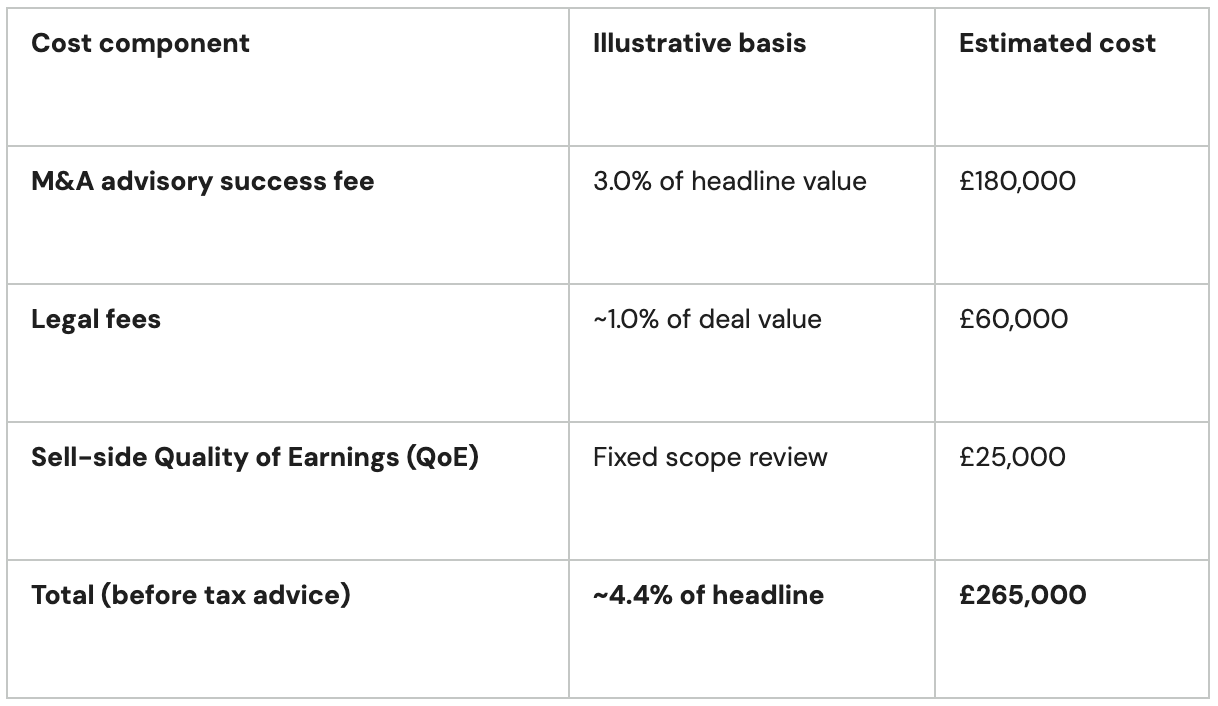
Now look at the detail that founders routinely overlook. Assume £2m of that £6m headline price is structured as an earn-out. If your advisory agreement charges the 3% success fee on the full headline value at completion, roughly £60,000 of that fee is paid upfront on contingent money you have not yet earned—and may never collect in full.
Founders tend to spend all their energy negotiating the headline fee percentage. In our experience, the basis on which that fee is calculated often matters far more.
How long it takes, and what it costs in time
A disciplined agency sale typically runs six to nine months from kick-off to completion:
- Preparation (~1 month): Getting the financial narrative, positioning, and core data room materials sharp before approaching anyone.
- Buyer engagement (3–6 months): Targeted outreach, chemistry meetings, deeper strategic conversations, and competitive offers.
- Heads of terms to completion (~2 months): Due diligence, legal drafting, and finalising completion mechanics.
The middle phase carries the widest variance because it depends on market appetite and how genuinely ready the business is when it launches. The final two months, however, are where founders feel the strain most acutely. Answering due diligence queries will consume a major slice of your working week at the exact moment the agency has to hit its numbers. Buyers track trading right up to the day you sign: a dip in pipeline or margin mid-process is the fastest way to invite a price renegotiation. That is a big part of why our role at Succeed is to absorb the process friction so leadership can keep running the agency.
Completion is rarely the finish line, either. Across UK advertising and marketing transactions, earn-out periods typically run for around three years, making cultural fit and realistic earn-out mechanics just as important as the day-one cheque.
Where the real money is won or lost
Transaction fees matter, and you should negotiate them intelligently. Yet across the exits we work on at Succeed, professional fees are almost never what determines a founder's final outcome. Valuation, deal structure, achievable earn-out terms, working capital mechanics, and tax timing all move the dial by far more.
The cost that hurts founders most is a deal that reaches heads of terms and then collapses, leaving behind months of abortive fees, exhausted leadership, and lost trading momentum. Having worked with agency founders at every stage of the journey as part of Unusual Group, we know that risk drops dramatically when an agency prepares before a process begins.
If an exit is on your horizon in the next few years, start with our Exit Readiness Assessment. It gives you a clear view of where your agency stands today—and exactly what to strengthen before you spend a penny on deal fees.
Ready to explore your options?
The right deal isn’t just money. It’s choice. It’s knowing what you built will keep thriving in the right hands.